
Monarch Watch: Raising Monarchs, Raising Hope!
By Kira Tackett
There’s something truly magical about holding a monarch caterpillar in your hand, knowing that this tiny, striped creature is part of one of the most extraordinary migrations on Earth. For me, that spark started early, from watching them as a child and now as an adult, raising monarchs alongside my mother through Monarch Watch. Founded by the lepidopterist Orley R. “Chip” Taylor, the organisation was conceived to combine education, research, and conservation around one of nature’s most evocative migrations.
Monarch Watch articulates its mission as follows: “Monarch Watch strives to provide the public with information about the biology of monarch butterflies, their spectacular migration, and how to use monarchs to further science education in primary and secondary schools. We engage in research on monarch migration biology and monarch population dynamics … We also promote protection of monarch habitats throughout North America.” Its broader vision reflects an urgent cross-border stewardship: “In recognition of the rapid loss of habitats and resources needed by monarch butterflies in the United States, Canada, and Mexico, our vision is the preservation of the monarch migration will require stewardship by the governments and private citizens of all three countries.” These citizens consist of not only scientists and students but everyday people into one massive fluttering network of “community scientists”, offering everyone the chance to contribute to real scientific research while experiencing the wonder of metamorphosis firsthand!
Seeing this metamorphosis in action, raising monarch caterpillars is both simple and scientifically fascinating. Female monarchs lay their eggs exclusively on milkweed (Asclepias spp.), the sole food source for their larvae. Milkweed contains cardiac glycosides which are chemical compounds that monarchs store in their tissues, making them distastefully poisonous to predators. This evolutionary adaptation is a perfect example of the relationship between plant chemistry and insect survival. The caterpillar then progresses through five growth stages, known as instars, before forming a jade-green chrysalis. After about 10 to 14 days, an adult butterfly emerges, pumps fluid into its wings, and prepares for flight.
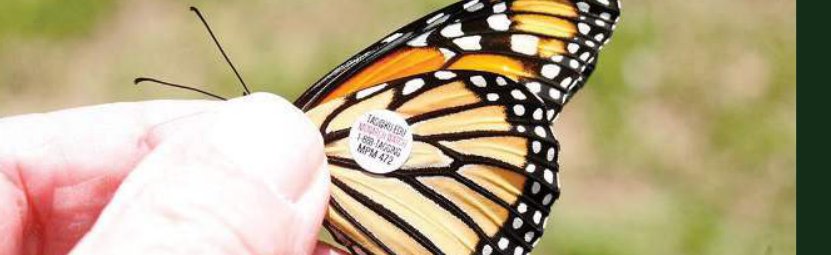
One of the programme’s most remarkable efforts is the great tagging initiative: volunteers carefully affix coded stickers to the hindwings of monarchs, sometimes wild, sometimes raised by hand, to trace their migration from North America to Mexico’s highland forests. Each recovered tag becomes a piece of a vast map, revealing when and where the travelers pass, how many endure the journey, and what stories their wings carry. This was the very work my mother and I did together. With milkweed growing in her garden, we gathered the caterpillars there and nurtured them through their fragile metamorphosis. And when the day came, we tagged them gently and let them go, watching the orange flickers vanish into the wind!
Recognising that habitat loss, especially of milkweed and nectar plants, is a principal threat, Monarch Watch launched its Waystation programme in 2005. These certified sites, home gardens, schoolyards, parks, are planted with native milkweeds and nectar flora to sustain monarchs during breeding, migration and overwintering phases. By 2023 the organisation had registered over 46,000 such waystations.
Why Monarchs matter? This wonderful species is renowned for their multi-generational migration, traveling thousands of miles between breeding grounds in North America and overwintering sites in Mexico. No single butterfly completes the entire journey; instead, successive generations continue the cycle. This extraordinary phenomenon highlights the interconnectedness of ecosystems across international borders. Monarch Watch’s work illuminates how factors such as climate change (e.g., warmer March or September temperatures), habitat loss, and agricultural practices are altering migration success. Moreover, by engaging schools, citizen scientists and gardeners, Monarch Watch brings science out of the lab and into backyards, like what it did with ours. In a world where wild corridors are shrinking and anthropogenic pressures mounting, this selfless organization offers both an elegy and a hope to inspire curiosity, stewardship, and a deeper appreciation for the natural world no mere reading of text books would be able to replicate for future generations to come.
Enjoying NatiPets?
Read the latest issue of Greater Cincinnati's pet magazine, free, or share your own pet's story with our community.