
Not All Pets Are Furry: Meet Marshmallow The Snake
By Kira Tackett
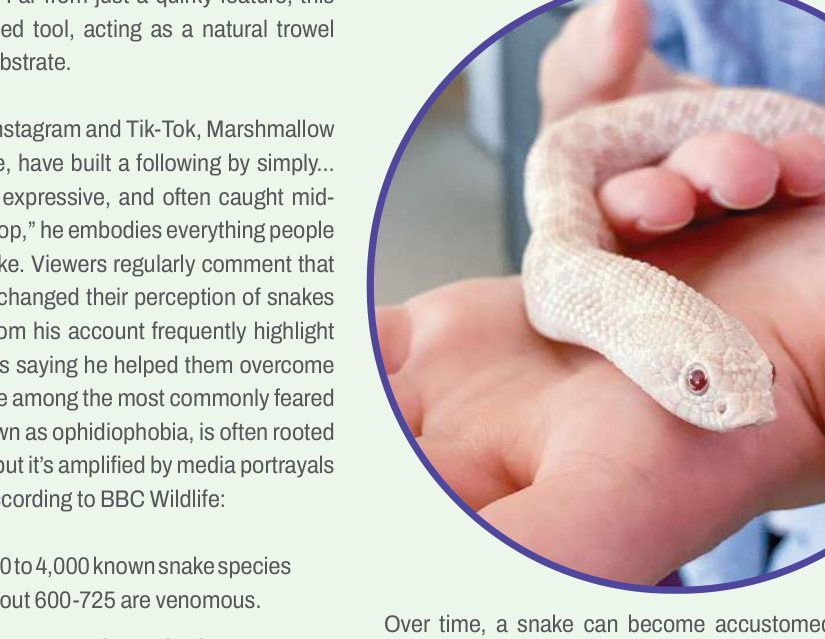
While the digital world has its thorns, it also blossoms into a vibrant classroom for the misunderstood, like Marshmallow!
Serving as an ambassador of sorts for his species, Marshmallow belongs to the group of snakes commonly known as hognose snakes, part of the genus Heterodon. Specifically, he is a Snow Western Hognose snake (Heterodon nasicus), giving him the iconic white/cream coloration in ode to his name, along with the distinctive, porcine tilt of his snout. Far from just a quirky feature, this ‘hognose’ is a specialized tool, acting as a natural trowel used to navigate their substrate.
Through platforms like Instagram and Tik-Tok, Marshmallow and his owner, Valentine, have built a following by simply… being himself! Curious, expressive, and often caught mid-yawn or mid-”dramatic flop,” he embodies everything people don’t expect from a snake. Viewers regularly comment that watching Marshmallow changed their perception of snakes entirely. In fact, posts from his account frequently highlight messages from followers saying he helped them overcome lifelong fears! Snakes are among the most commonly feared animals worldwide; known as ophidiophobia, is often rooted in evolutionary caution, but it’s amplified by media portrayals and lack of exposure. According to BBC Wildlife:
- Out of roughly 3,500 to 4,000 known snake species worldwide, only about 600 to 725 are venomous.
- And of those venomous species, only about 200 to 250 (roughly 5 to 7% of all snake species) possess venom potent enough to be dangerous or lethal to humans.
Hognoses of which are a species definitely possessing neither of these traits!
Here’s where things get interesting. There is a persistent myth that reptiles are incapable of bonding with humans. That’s not entirely true. While they don’t necessarily bond the same way mammals do, science still shows something more nuanced. Conducted by Anthrozoös, a 2022 study on the human-reptile bond found that reptile owners frequently describe feelings of affection, companionship, and even love toward their animals, with many considering them family members. So what does that mean in practice?
Snakes form what is known as ‘associative bonds’, not emotional attachments in the mammalian sense. They learn:
- Who feeds them
- Who handles them safely
- What environments feel secure
Over time, a snake can become accustomed to its owner, showing reduced stress, calmer behavior, and even a preference for familiar handling routines.
Furthermore, snakes play critical ecological roles, particularly in controlling rodent populations and maintaining balance in food webs. Yet they are frequently persecuted due to fear mongering and misinformation. What makes Marshmallow especially effective is that the education doesn’t feel like a lecture. Rather, it’s woven into entertainment. As viewers watch his antics from the safety of their screens, the myth of the ‘aggressive serpent’ evaporates and instead, they see a little charismatic creature that prefers a dramatic bluff over a bite. It is a testament to the power of creators like Valentine that a small snake may stand on a digital pedestal to advocate for his species. Even without formal explanation, exposure alone builds understanding…and that is often the first step toward conservation awareness.
Enjoying NatiPets?
Read the latest issue of Greater Cincinnati's pet magazine, free, or share your own pet's story with our community.