Doodles: No Sneezing and Lots of Zoomies
By Kira Tackett
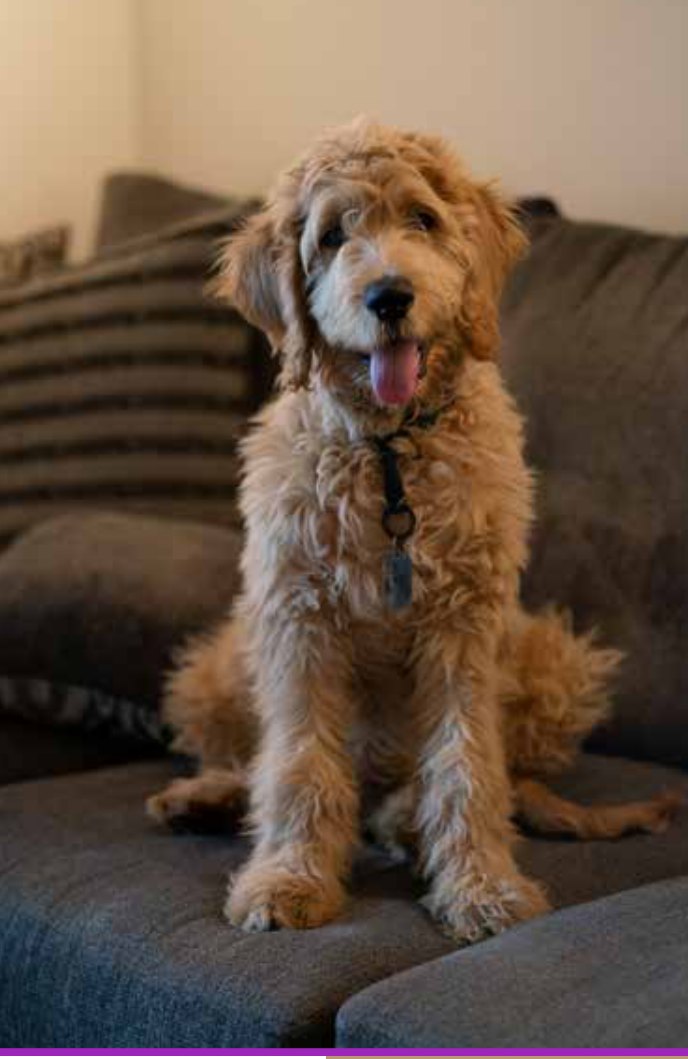
For years growing up, the idea of a dog or cat living in our household was an impossible dream, kept at a distance by allergies in the family. Until 2021, when a teddy bear-shaped bundle of Goldendoodle named Jackson bounded into our lives through adoption.
Goldendoodles are a breed which arose in the United States during the 1990s, created through the crossing of Golden Retrievers and Poodles with an objective both practical and heartfelt: to combine the Poodle’s intelligence, trainability, and allergy-conscious coat qualities with the Golden Retriever’s famously friendly and loving disposition. Though the breed’s precise beginnings remain somewhat uncertain, its appeal is easy to understand. Goldendoodles offer warmth, cleverness, sociability, and an endearing eagerness to connect. Over time, their popularity has grown enormously, and their gentle, outgoing personalities have made them valuable therapy dogs, offering comfort in hospitals and nursing homes as well.
They come in three size categories, mini, medium, and standard, depending on the Poodle parent. Mini Goldendoodles may weigh as little as 15 to 35 lbs, while standard dogs can reach 50 to 90 lbs. Because of this, it is important that a household, yard, or daily routine has enough room to accommodate the larger sizes, especially since, speaking from my own experience, Goldendoodles are very energetic. Our own Jackson doesn’t seem to have an off button sometimes! Yet beneath all that exuberance is a remarkably intelligent dog, even if Jackson occasionally attempts to disguise this fact beneath selective innocence. He is deeply attentive to tone, responsive to the emotional atmosphere around him and even clever enough to recognize each of us by name.
However, let us establish that no dog breed is entirely allergen-free. These dogs are just the ones with the least likelihood of triggering allergic reactions. Consequently, the presence of a hypoallergenic dog affords no absolute immunity for sensitive cohabitants; it simply implies that, in comparison to other breeds, the dog is considerably less likely to induce an allergic reaction. However, hypoallergenic dogs all have a few characteristics in common:
- They don’t shed, which in turn creates less dander.
- Their specific coat structure impedes the build-up of dander particles.
- They maintain streamlined, single-layered coats, avoiding the prolific dander associated with dense undercoats.
The central idea here is never the fur we can see, but the microscopic dander we cannot, along with their saliva and urine. Furthermore, low shedding does not mean low maintenance. Goldendoodles and other curly-coated dogs require:
- Professional grooming every 4 to 8 weeks, often costing well over a hundred dollars per session.
- Daily brushing to prevent matting.
- Regular ear cleaning, nail trimming, and coat trimming.
While Goldendoodles dominate the doodle category, several other breeds are known for low shedding and may be better choices depending on the availability of their owners and the sizes of their property:
- Poodle (Toy, Miniature, Standard): The foundation of most hypoallergenic mixes. Poodles have tight, curly coats that trap hair and dander, making them one of the most allergy-friendly breeds.
- Labradoodle: A cross between a Labrador Retriever and a Poodle, originally bred as guide dogs. Like Goldendoodles, their coats vary widely.
- Portuguese Water Dog: Known for their curly, low-shedding coat and athletic nature.
- Bichon Frise: A small breed with a soft, curly coat that sheds minimally.
- Schnauzer (Mini, Standard, Giant): Low-shedding wiry coats and strong, loyal personalities.
- Soft-Coated Wheaten Terrier: Single-coated terriers that shed less than double-coated breeds.
- Yorkshire Terrier: Silky, hair-like coat that sheds very little.
Kira Tackett
Editor, NatiPets
Kira Tackett is the editor of NatiPets, where she covers pet care, adoption stories and local pet news for pet parents across Greater Cincinnati, Northern Kentucky and Southeast Indiana.
Enjoying NatiPets?
Read the latest issue of Greater Cincinnati's pet magazine, free, or share your own pet's story with our community.