Why Portraits Still Matter
By Susan Gertz, Kindred Spirits Pet Photography
How portraits of pets and their people preserve the relationships that shape a family.
We have never taken more pictures of our families, including pets, than we do today. Our phones hold thousands of captures, and now artificial intelligence can create almost any image we can imagine. Clearly, we have pictures, and lots of them. But do we have portraits?
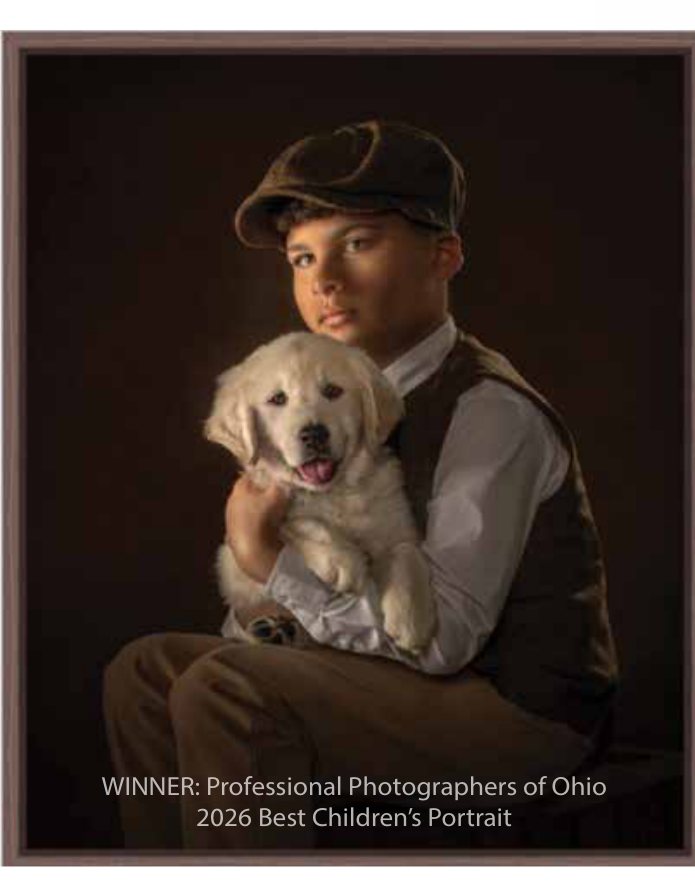
The difference is intention. Most phone photos are snapshots, informal, of-the-moment images that make wonderful memory keepers. A portrait is something else. It’s planned. The making of it is an event. Clothing, setting, pose, and expression are chosen deliberately to reveal personality and relationship. The finished portrait is a shared vision between artist and subject, meant to be displayed and passed down.
Portraits have featured pets with their people for centuries. In Anthony van Dyck’s The Three Eldest Children of Charles I (1636), the future King Charles II stands with his younger siblings while two spaniels sit at their feet. Nearly four centuries later, the painting still hangs at Windsor Castle. We can wonder how much scampering and tail wagging happened as the artist worked to capture the scene.
Charles II was so closely associated with toy spaniels that his name lives on in the Cavalier King Charles Spaniel, a modern breed developed centuries later.
As photography spread in the Victorian era, it changed the method of portraiture, but not the intention behind it. Photographers and families planned for a portrait with the same care, and pets still held their place in the family story. A photograph from about 1880 shows a child in an elaborate lace collar with a dog sitting close by. We’ll never know their names or how child and dog spent their time together. But more than 140 years later, people can still hold that photograph and wonder.
These historical portraits survive as physical objects: paint on canvas and photographs printed on paper. They can live on walls, in albums, and in our hands. How remarkable that we can still contemplate the lives of these children and dogs from generations ago by studying their portraits.
But how certain are we that our thousands of digital pictures will be available to our descendants 100 or 200 years from now? Devices fail. Passwords are lost. Accounts disappear. Technology changes.
When we choose to have a portrait made in this digital era, it is created with the same care as portraits throughout history. And it is given a physical presence in the world.
A portrait on the wall is not waiting inside a device to be found. It remains present in the life of the family.
I’ve been privileged to create pet portraits for hundreds of families. The sad truth is that we usually outlive our pets, and many families reach out after a pet has passed. In their heartbreak, they tell me what it means to see that portrait on the wall. I offer my condolences, and I always say the same thing: “I remember that day.” And I do. Not just the canvas, but the day itself.
Some days stay with me especially clearly:
- The day an impossibly old Miniature Poodle rode proudly in her aging owner’s arms for their portrait together.
- The day a young woman’s emotional support dog gave her the confidence to step in front of the camera.
- The day a determined brain injury survivor walked in supported by her stability service dog in harness.
While they are still beside us, a portrait of our pet makes us smile. Years later, when our companion isn’t with us any longer, it holds the bittersweet memory of the way they saw us as the most important person in their world.
A portrait cannot make their lives longer, and it cannot contain everything we remember. But a portrait can give those memories a place to gather.
A portrait with a beloved animal says: This animal was here. This bond was real. This story is worth carrying forward.
Enjoying NatiPets?
Read the latest issue of Greater Cincinnati's pet magazine, free, or share your own pet's story with our community.